The Credit View: Building a Defensive Sector Strategy (Newsletter)
Defensive growth has guided where we invest for over 25 years
At New Mountain, our investment philosophy is centered on a single core concept: defensive growth. For us, that means focusing on durable, non-discretionary areas of the economy while avoiding sectors that are cyclical, volatile or secularly challenged. We believe this approach results in more resilient portfolios that are less correlated with the broader economy.
We define defensive growth as sectors with the following characteristics:
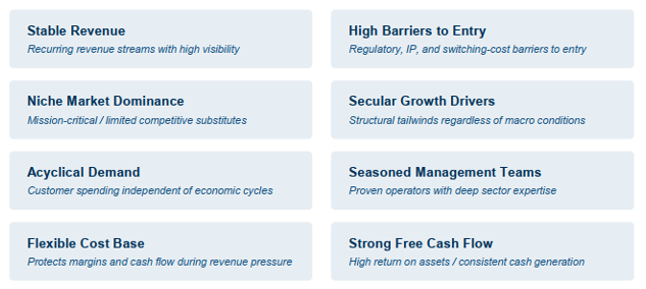
One of our long-standing sector power alleys is infrastructure services, where we have spent 17 years researching and investing in companies across the space. We like the fact that many businesses in this sector have long-duration, non-discretionary, recurring revenue streams in areas with high barriers to entry that are backed by a diversified base of corporate, government and municipal customers. Over multiple decades, we have invested in ~40 individual companies across niches ranging from water infrastructure to utility and field services, and more recently, services supporting data centers and power infrastructure.
We apply the same framework in business and financial services, with a particular focus on subsectors such as insurance and benefits services and integrated payments. In insurance and benefits services, demand tends to remain stable across economic cycles and customer relationships are often long-standing. Integrated payments businesses are typically deeply embedded in customers’ day-to-day workflows. Across both areas, these characteristics can support recurring demand and high switching costs, while generally being less sensitive to credit cycles or interest rates.
Other examples of defensive growth industries include mission-critical enterprise software, subscription database companies and certain niches of healthcare technology, among others.
We are sector specialists, while remaining flexible as markets evolve
While our underlying philosophy has remained consistent, we continue to refine how we apply it as industries and markets evolve. Technology, regulation, competition and customer behavior can reshape where defensive characteristics are found, sometimes quickly and sometimes over many years. As a result, we continually reassess our sectors and subsectors and evolve our core power alleys as appropriate.
Every New Mountain investment professional participates in an annual sector deep-dive process designed to revisit our existing areas of focus and surface our strongest new ideas. Whether those ideas lead us into new industries or deeper into sectors we have followed for years, the goal is the same: to develop a well-informed view of an industry’s growth prospects, competitive advantages and potential risks before committing capital.
Some of the greatest challenges in investing arise when the industry melts beneath your feet—our defensive growth philosophy seeks to avoid that. Our sector knowledge compounds over the years and decades we spend in these areas. New Mountain Capital’s private equity team spends significant time diligencing and ultimately owning businesses in these sectors; in doing so, we develop relationships with management teams, industry executives and operators that benefit the full New Mountain Credit platform.
Importantly, we approach investing as one integrated team, which gives our credit business access to the same firmwide sector expertise, industry relationships and operating resources that inform investments across the broader New Mountain platform. Today, New Mountain includes approximately 320 employees and Senior Advisors, supported by roughly 120 industry executives. In addition, our private equity portfolio companies collectively employ approximately 133,000 people, reflecting the breadth of our operating experience across these sectors.
Why defensive growth is particularly important today
Many of the most prominent risks in today’s market are macroeconomic in nature. Headlines are dominated by concerns about inflation, consumer confidence, commodity prices and more. Our defensive growth mantra serves as protection against many of these risks.
Consumer confidence – defensive growth sectors are generally acyclical and tend to be less dependent on the strength of the consumer.
Supply chain and commodity price disruption – by design, defensive growth sectors are generally asset-light, service- and technology-oriented in nature, with limited reliance on the import or export of raw materials and physical goods.
Inflation – in a sustained inflationary environment that may contribute to “higher for longer” interest rates, our defensive growth sectors are largely insulated from inflation-sensitive areas of the economy like retail, restaurants and construction.
Geopolitical instability – our focus on asset-light, domestically oriented businesses generally limits exposure to cross-border trade and other disruptions stemming from geopolitical events.
Defensive growth for New Mountain Credit
Defensive growth is particularly important for New Mountain Credit because the risk-return profile of lending is asymmetric. Our upside is generally limited to a loan’s contractual return and repayment of principal, while a credit loss can result in permanent impairment. That makes it critical to understand not only a business’s leverage, documentation, cash flow and enterprise value, but also the resilience of its industry and the company’s competitive position within it. A loan that looks well-structured today still needs to be repaid several years from now, often by a company operating in an industry that has continued to evolve.
That is why defensive growth is not a tactic we apply in select markets; it is the foundation of how we lend, and it has been our consistent strategy since we launched our credit platform in 2008. It is important to highlight that this approach differs from the broader generalist strategies commonly employed across the direct lending market, as we focus on a more select group of industries.
Over the past 18 years, we have invested in credit where demand is durable, leveraging the deep knowledge of the sectors we know best and drawing on the full New Mountain platform to make high-conviction credit decisions. For New Mountain Credit, that discipline is how we seek to protect capital and deliver steady, enhanced income throughout market cycles. Whatever the next cycle brings, we believe defensive growth positions the portfolio well not only for today's environment, but also for the years ahead.
View source version on LinkedIn and subscribe for future updates: https://www.linkedin.com/pulse/building-defensive-sector-strategy-john-kline-v56vc/